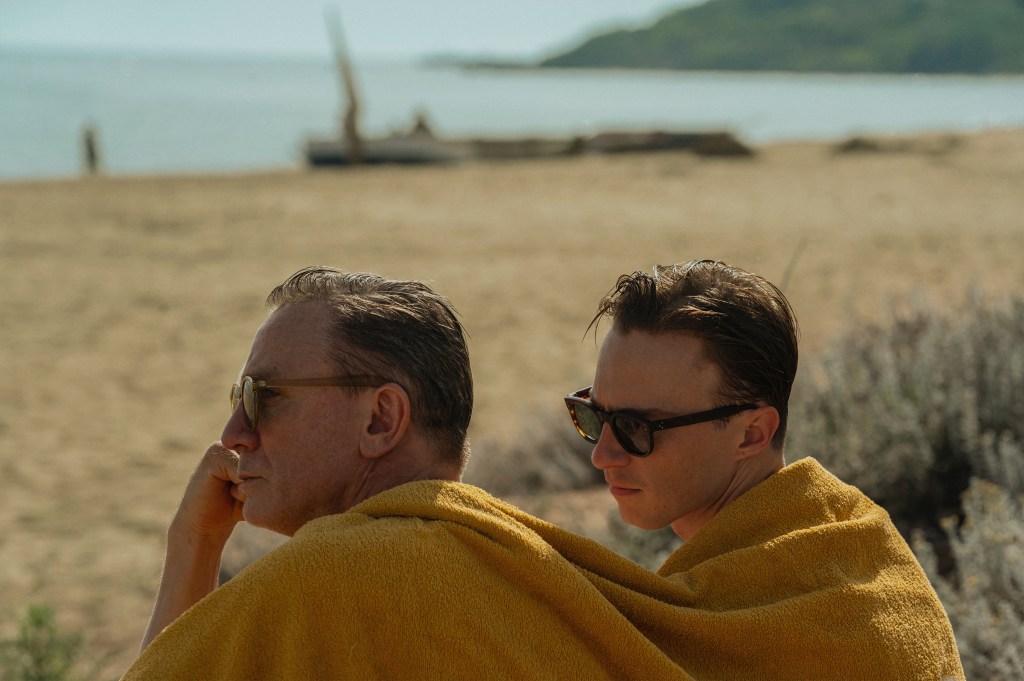
Luca Guadagnino’s “Queer” was largely entertaining, but I wanted to like it more than I did. I mean, what’s not to like about a gay A24 film starring one of the hunkiest leading men of our time and a hot young actor? It’s right up my alley, but it just didn’t quite come together for me in the end.
The film follows William Lee (Daniel Craig), an expat in his late 40s who leads a debaucherous life amidst a small American community in Mexico City in the 1950s. But when a young student and GI named Eugene Allerton (Drew Starkey) arrives in town, Lee is captivated and strives to make a meaningful connection with him. Eventually, Lee leads Allerton to the jungles of South America as he searches for a plant used to make ayahuasca with hopes of it giving him telepathic abilities.
The movie is split into three acts and an epilogue, which makes it feel a little disjointed. I’m not a fan of this cinematic device in general because it often feels like a cop out when a storyteller isn’t sure how to weave a clear plot together. In this film’s case, it starts strong with the first chapters outlining a steamy back and forth between Lee and Allerton, but the movie takes a trippy turn in the final act that I don’t think it quite recovers from.
(Spoilers ahead)
Lee and Allerton end up doing ayahuasca towards the end of the film and while I thought the visuals in that scene were fantastic, it was the tipping point where the movie started to lose me. I love some surrealism, but the sequences that followed the ayahuasca trip didn’t seem to match the tone of the beginning of the film.
I also came away from “Queer” a little confused on what happened to Allerton who seemingly just vanished as he and Lee were leaving the jungle. Then, we’re told in the epilogue two years in the future that he’s alive and went back down to South America with someone else. I wasn’t sure if that was reliable information since we just switched from such a fantastical sequence the scene before. If it was reliable, I think it was poorly explained.
When it comes to acting, Craig definitely disappeared into the role of Lee and the character is far different from what we typically see him play. Going into the theater, I thought I would like Lee and be able to identify with him, yet I found myself getting creeped out by him more than anything. I think the romance between him and Allerton would have been more believable without that ick factor.
As for Starkey, I think “Queer” was a star-launching vehicle for him even more than his part on Netflix’s “Outer Banks.” He played off Craig extremely well in the textured role of Allerton and he was strikingly beautiful throughout. If you’re attracted to men, he’s the reason to see the film!
The supporting characters were excellent. Jason Schwartzman had a really great side role as Lee’s friend Joe Guidry, another gay man living it up in Mexico City. His quippy lines in scenes with Lee were funny and it brought levity to the often dark film.
While I didn’t love the jungle scenes as much as earlier parts, I thought Lesley Manville was great as Dr. Cotter, a strange woman living in the jungle. She was pretty unrecognizable and kept the audience on its toes as Lee tried to convince her to help him get his hands on ayahuasca.
Singer Omar Apollo also makes a short appearance in the film. He doesn’t have many lines, but the eroticism of his scene won’t easily be forgotten.
The movie is definitely sexy. From the bedroom scenes to the way it’s filmed, sex is a big theme. Throughout the movie, Lee questions what Allerton’s sexuality is. It’s seemingly confirmed that he’s interested in men when they have sexual encounters, but Allerton later says, “I’m not queer, I’m disembodied.” That phrase is repeated by another character, but the meaning wasn’t clear. I guess I interpret it to mean that he doesn’t identify as queer and he disassociates from his body when it comes to sex.
I think the film also discusses drug use in an interesting way. We learn that Lee was in Mexico partly because he couldn’t get away with his hard drug use in the U.S. It was interesting to see how drugs were apparently used in 1950s Mexico City, especially because the queer community has a unique relationship with different recreational substances to this day.
Overall, I did enjoy “Queer” and I would recommend it to others, especially those in the LGBTQ+ community. Just know that it’s more out there than you might think. It’s not as mainstream as Guadagnino’s other films like “Call Me By Your Name” or “Challengers,” but it’s still worth a watch!


 Pop Commentary
Leave a comment